SCENE CONTEXT

Live-action cinematic film footage, shot on 35mm anamorphic film, real photographed footage, not animation and not a render. Ten-second single take.

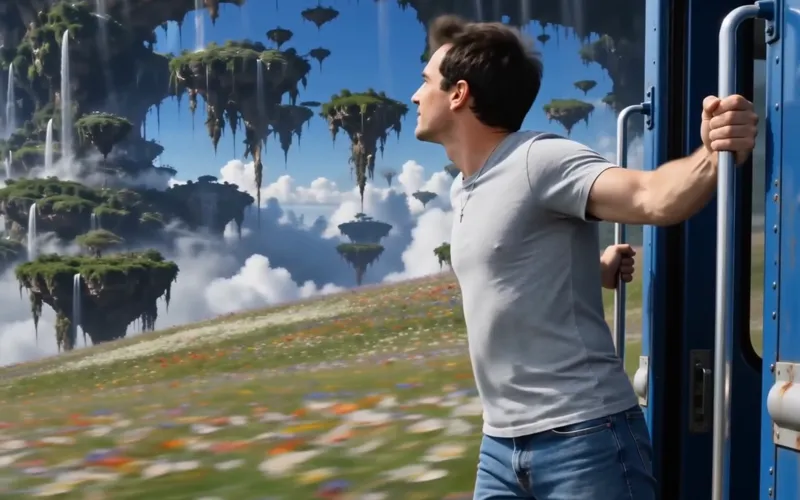
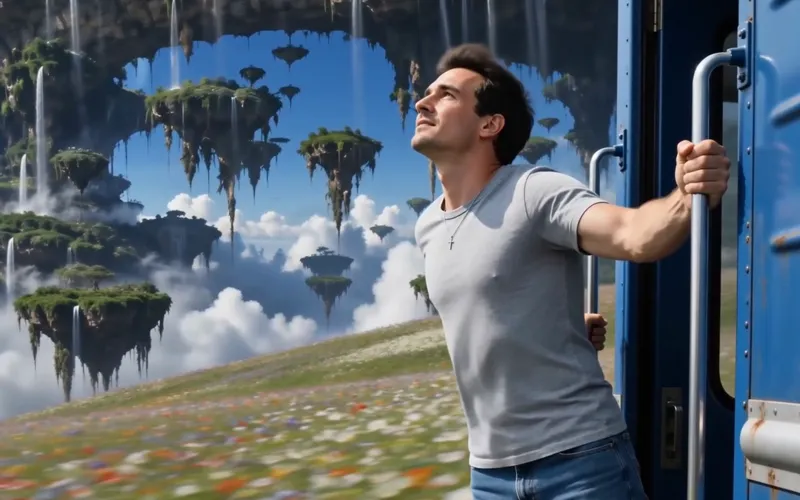
Filmed by a person riding a moving train, standing in an open doorway with the camera held out at the carriage side. The camera pans right in one smooth rotation, from looking inward at the dim carriage interior, sweeping past the door frame, out to look forward along the flank of the moving train, where the adult man from @[Image 1](image_1) leans out of the next doorway ahead, both hands gripping the vertical steel grab bars, arms extended, body arched backward into the airstream, hair moving in the wind, enjoying the view.

The man must preserve the identity, facial structure, hairstyle, body proportions, clothing and overall appearance shown in @[Image 1](image_1).

Beyond the train, a vast surreal flower world with an impossibly curved horizon sweeps past at speed. The geography is impossible; the photography is completely ordinary and real.

The impossible environment must look physically photographed, not digitally rendered.

CAMERA POSITION LOCK: CRITICAL

The camera occupies one fixed point in space relative to the train for the entire shot and does not travel anywhere.

The camera operator stands on the door sill of an open doorway, one hand on a grab bar, the other holding the camera out at arm's length at the outer plane of the doorway.

Lens position:

approximately 1.55 metres above the sill,
approximately 30 cm outside the carriage flank,
level with the horizon,
physically attached to the movement of the train.

From this fixed point the camera performs one single smooth pan to the right of approximately 100 degrees, spread across the first four seconds, then holds.

The camera rotates in place only.

No dolly.
No walking.
No stepping.
No leaning inward.
No leaning outward.
No travelling forward.
No travelling backward.
No push-in.
No pull-back.
No zoom.
No rise.
No fall.
No orbit.
No arc.
No crane movement.

The camera's physical position relative to the train never changes.

After the pan completes, the near door frame and cobalt-blue carriage flank remain visible in the immediate foreground at the extreme right edge of the frame for the rest of the shot.

This foreground geometry is essential physical proof that the camera is aboard the train.

Never allow the camera to become a free-floating exterior camera.

TRAIN GEOMETRY LOCK: CRITICAL

The train is one single continuous line of identical cobalt-blue passenger carriages coupled end to end.

All carriages run on the same track in the same direction.

The camera is aboard this same train.

The adult man from @[Image 1](image_1) leans out of the next open doorway forward along the same flank, approximately 6 metres ahead of the lens, on the same side of the same train.

The distance between the camera and his doorway stays fixed for the entire exterior portion of the shot.

Zero relative movement between camera and train.

The track curves gently to the left, so the carriages ahead remain visible receding into the distance in one continuous line, each slightly further left than the last.

The wheels remain aligned on the same rails.

No branching track.
No perpendicular carriages.
No L-shaped train.
No angled disconnected carriage.
No second train.
No detached carriage.
No exterior chase camera.
No aerial view.
No free-floating camera.

The train must always read as one physically continuous object.

CHARACTER: IDENTITY LOCK

The only person visible in the shot is the adult man from @[Image 1](image_1).

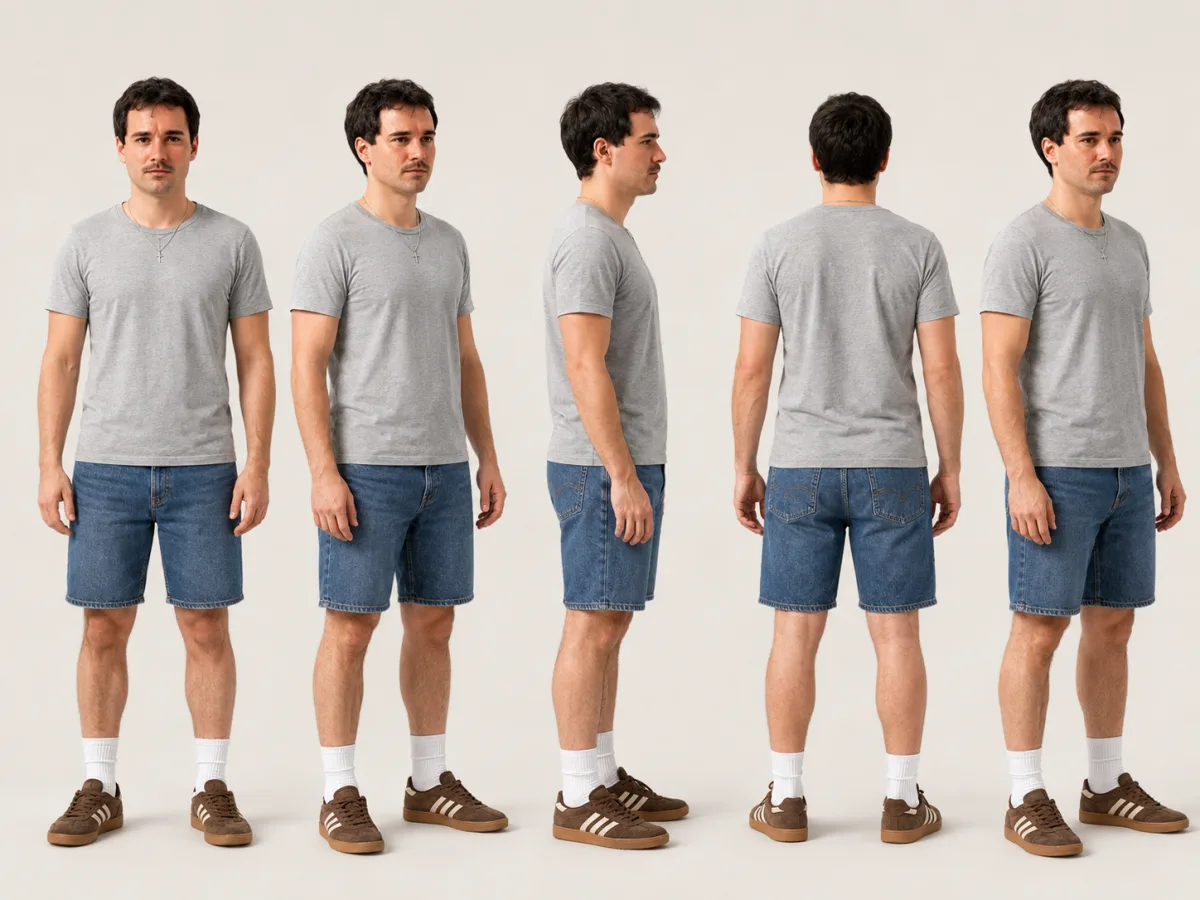
Use @[Image 1](image_1) as the strict 360-degree identity, anatomy and wardrobe reference.

Preserve exactly:

adult male appearance,
facial structure,
facial proportions,
dark short slightly tousled hair,
subtle moustache and facial hair,
natural skin tone,
body build,
shoulder width,
torso proportions,
arm proportions,
leg proportions,
grey short-sleeve crew-neck T-shirt,
blue denim shorts,
white crew socks,
brown low-top sneakers.

Do not reinterpret his appearance.

Do not change his age.

Do not make him look like a teenager or child.

Do not replace the shorts with trousers.

Do not alter the T-shirt colour.

Do not change the shoes.

Do not add:

jackets,
hats,
bags,
jewellery,
watches,
bracelets,
necklaces,
rings,
sunglasses.

His appearance must remain recognizably the same person from every visible angle.

He is an ordinary adult man with realistic human proportions and natural asymmetry.

His body proportions must come from @[Image 1](image_1), not from an invented idealized body.

Real human skin:

visible pores,
subtle uneven tone,
minor natural redness,
fine arm and leg hair,
slight facial texture,
small imperfections,
light perspiration,
natural highlight response.

No beautification.

No airbrushing.

No symmetry correction.

No face reshaping.

No body slimming.

No muscular exaggeration.

No plastic skin.

No waxy skin.

No model-like modification.

No artificial youthfulness.

He is seen primarily from behind and three-quarter rear or side angles, corresponding naturally to the 360-degree reference sheet.

His face may become partially visible as he turns toward the landscape, but he never looks toward the camera.

POSE

He stands firmly on the sill of the doorway ahead, facing outward and forward along the direction of travel.

Right hand grips the forward vertical grab bar.

Left hand grips the rear vertical grab bar.

Both arms are extended and carrying real physical load, but not hyperextended.

His feet remain fully planted on the sill.

Feet approximately shoulder-width apart.

Knees slightly bent to absorb the movement of the carriage.

His hips remain close to the doorway.

His upper torso leans and arches backward into the airflow.

Shoulders open.

Chest facing diagonally outward.

Head lifted slightly into the wind.

His posture should feel exhilarating but physically believable, a real adult man balancing against the wind and movement of a train.

Not a superhero pose.

Not an extreme impossible backbend.

He maintains both hand grips for the entire exterior portion of the shot.

His feet never leave the sill.

CHARACTER SCALE

Use the proportions and apparent height from @[Image 1](image_1) as the human scale reference.

Do not stretch or compress his body to fit the train doorway.

The doorway is approximately 1.90 metres tall and 1.30 metres wide.

His body must remain proportionally identical to the reference.

At approximately 6 metres from the lens on the wide anamorphic lens, he occupies roughly 45–55% of the frame's vertical height after the pan completes.

CAPTURE MEDIUM: CRITICAL FOR REALISM

Shot on 35mm film through Panavision C-Series anamorphic lenses on an Arricam LT.

Kodak Vision3 50D daylight stock.

Photochemically developed.

Scanned at 4K.

Every real-lens and real-film characteristic must remain visible.

GRAIN

Organic 35mm grain structure.

Grain shifts naturally from frame to frame.

Finer in the bright exterior.

More noticeable and slightly chromatic in the dim interior shadows.

Never static digital noise.

HALATION

Subtle warm red-orange halation around the brightest highlights:

doorway opening,
sun glints on steel bars,
bright waterfalls,
sunlit flower highlights,
rim-light on hair,
highlights on skin.

ANAMORPHIC CHARACTER

Subtle anamorphic image character.

Oval out-of-focus highlights.

Very gentle barrel distortion near the extreme edges.

Faint horizontal blue streak flare only when the sun catches the front element.

No exaggerated sci-fi flares.

CHROMATIC ABERRATION

Slight purple-green fringing on extreme high-contrast edges:

door frame against sky,
steel bars against landscape,
bright flower edges against shadow.

FOCUS BEHAVIOUR

Real optical focus.

Finite depth of field.

Very slight focus breathing.

Subtle softness toward the corners.

Not everything equally sharp.

No artificial edge enhancement.

BLACK LEVELS

Film blacks remain slightly lifted.

Interior shadows retain faint blue-grey detail.

Visible grain remains present inside dark areas.

Never pure digital black.

HIGHLIGHT ROLL-OFF

Smooth filmic shoulder into bright highlights.

No harsh clipping.

No digital blowout.

No artificial glow bloom.

GATE WEAVE

Almost imperceptible frame-to-frame image instability consistent with real 35mm film running through a gate.

IMPERFECTION LOCK: CRITICAL

Nothing in the frame is perfectly clean, perfectly even, mathematically symmetrical or digitally sterile.

Fine dust and pollen motes drift through the sunlight near the doorway.

The cobalt-blue paint reflects unevenly across the carriage panels.

Some sections appear duller.

Others catch soft directional sheen.

None of the paint looks mirror-clean.

Steel grab bars contain:

faint fingerprint smears,
uneven polish,
subtle wear,
different reflectivity where hands commonly grip.

Window glass contains:

small streaks,
fingerprints,
partial reflections of sky,
partial reflections of the doorway,
slightly uneven surface response.

The grey rubber floor contains:

scuff marks,
subtle dirt variation,
inconsistent sheen.

The man's skin remains real.

Individual arm hairs catch light.

Subtle perspiration is visible.

His hair consists of individual strands rather than a sculpted mass.

His clothing contains natural irregular wrinkles, fabric tension and visible textile weave.

No repeated procedural surface pattern.

No perfect symmetry.

COLOUR AND VIBRANCE

The image is vivid, but all colour intensity comes from natural sunlight, polarisation and real film response.

No digital oversaturation.

Hard midday-to-early-afternoon sunlight produces the intensity.

Naturally polarised sky.

Kodak Vision3 50D renders greens with real tonal separation.

Vegetation ranges from:

deep viridian,
emerald,
sunlit yellow-green,
cooler shadow green.

Blues remain rich cyan-cobalt without clipping.

Scarlet poppies remain saturated while retaining petal texture.

Human skin stays warm, natural and comparatively restrained against the saturated landscape.

Cool atmospheric blue haze covers distant terrain.

Warm sunlight dominates nearby objects.

No neon.

No HDR.

No uniformly saturated surfaces.

No beauty fill.

No artificial colour glow.

SET

Real vintage narrow-gauge passenger train.

Photographed, not rendered.

Cobalt-blue painted steel carriages.

Well-maintained.

Clean but naturally imperfect.

No graffiti.

No severe rust.

No destroyed paint.

Long rows of small square windows along each carriage side.

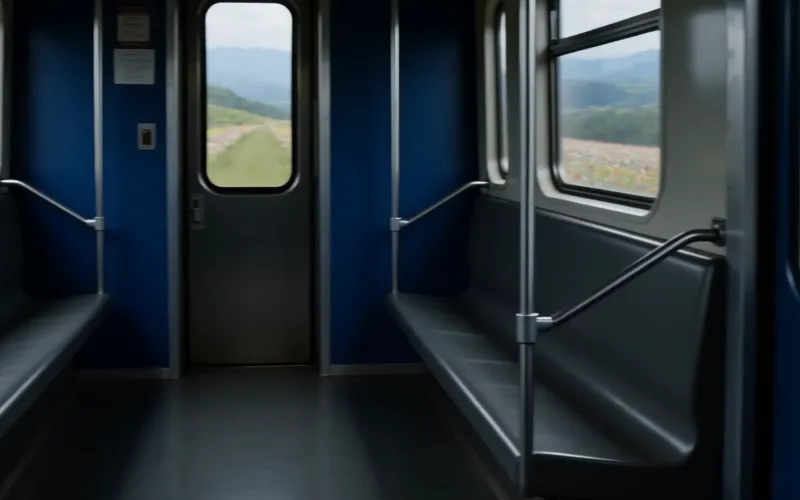
Interior contains:

narrow central aisle,
bench seats along both walls,
vertical stanchion poles,
grey rubber flooring,
blue painted interior panels.

Each open doorway:

approximately 1.90 metres tall,
approximately 1.30 metres wide,
one vertical steel grab bar on either side,
grab bars approximately 32 mm diameter.

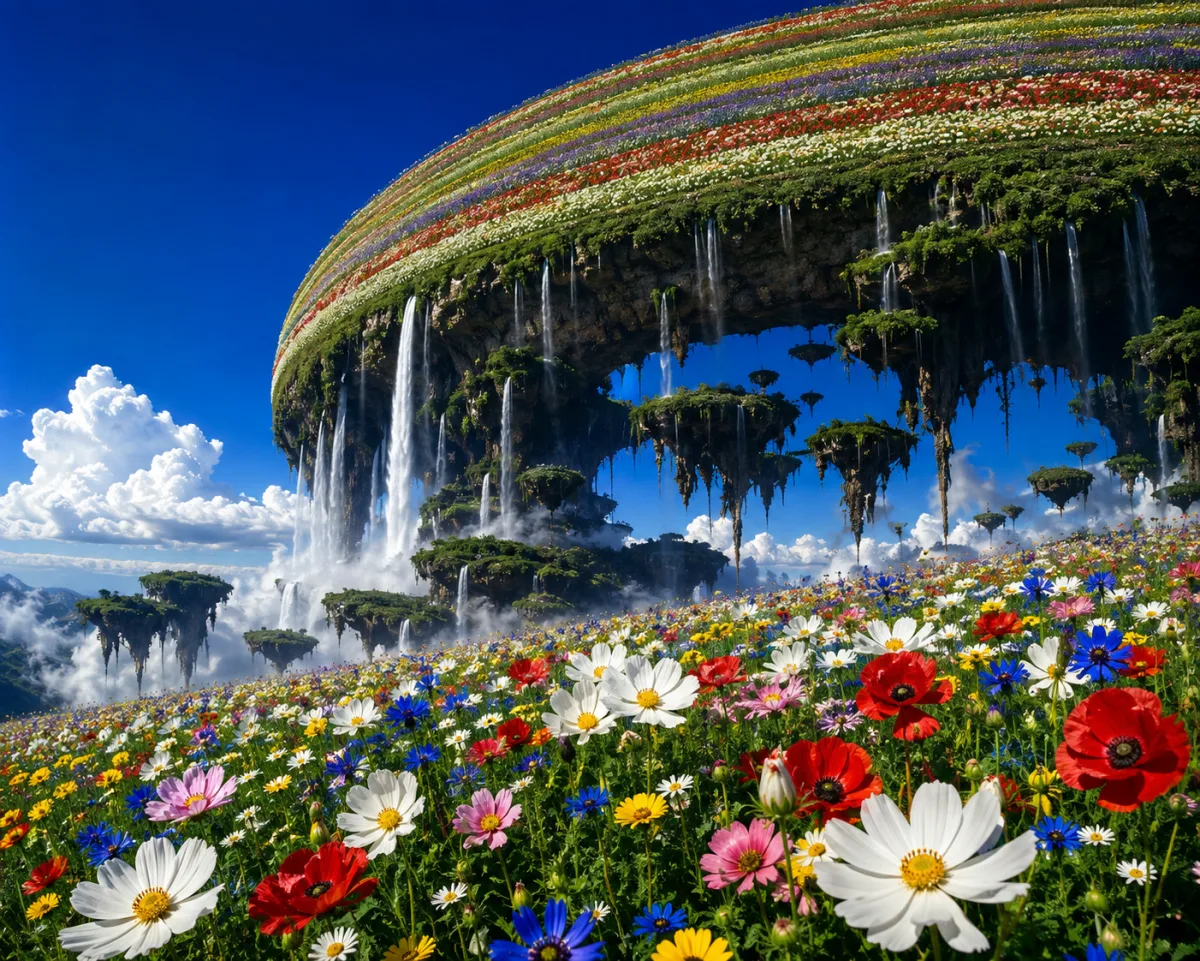
LANDSCAPE: @[Image 2](image_2)

Beyond and beside the train is a colossal physically photographed surreal flower world based on @[Image 2](image_2).

The immediate environment is a boundless emerald meadow packed edge-to-edge with vibrant real flowers.

Visible flower species and colours:

white cosmos,
white daisies,
scarlet poppies,
cobalt cornflowers,
blush pink flowers,
small yellow buttercup-like blooms.

Individual flowers remain botanically detailed.

Individual grass blades are visible where motion blur allows.

The near meadow races past the train.

Farther away the landscape begins to rise upward.

The land bends impossibly into an enormous monumental arc sweeping across the upper portion of the sky.

The arc should read as a gigantic physical landmass, not merely a curved horizon.

Its upper surface is densely covered with grass and wildflowers.

Flower growth forms large natural bands and ridged rings following the curvature of the terrain.

The underside of the arc consists of dark exposed rock strata, soil, roots, moss and hanging vegetation.

A huge dark open void is visible beneath the centre of the arc.

Enormous waterfalls pour from the underside of the landmass.

The largest waterfalls drop more than 300 metres.

They appear as long white ribbons breaking into spray and drifting mist.

Numerous smaller waterfalls spill from ledges and terraces across the underside.

Several gigantic floating slabs of turf, meadow and forest remain suspended below the arc.

Some floating landmasses carry ancient enormous trees.

Roots and rock formations extend from their undersides.

The environment must look physically real.

Real botanical texture.

Real geological strata.

Real waterfalls.

Real mist.

Real cloud volume.

No smooth modelled terrain.

No repeated procedural geometry.

No fantasy illustration texture.

No videogame environment.

No miniature look.

SKY

Large expanse of deep cobalt-to-cerulean sky.

Particularly visible toward screen-left.

Towering sunlit cumulus clouds sit along the horizon.

Clouds look physically atmospheric:

real water vapour,
bright sunlit edges,
soft internal shadow,
real volume,
subtle translucency,
natural density.

No painted fantasy clouds.

SCALE LOCK

Human scale remains physically believable.

The man retains the exact body proportions of @[Image 1](image_1).

Doorway approximately 1.90 metres tall.

Grab bars approximately 1.30 metres apart.

The man stands approximately 6 metres from the lens.

He occupies roughly 45–55% of the vertical frame after the pan.

Each train carriage is approximately 15 metres long.

Two or three carriages ahead remain visible along the leftward curve.

The surreal arc begins approximately 2 kilometres away.

Largest waterfall drops exceed 300 metres.

Floating islands range from tens to hundreds of metres across.

The environment must feel enormous because of perspective, atmospheric depth and parallax.

Not because of fisheye distortion.

ACTION TIMING

0:00–0:02

Camera points entirely inward toward the carriage interior.

Visible:

dim central aisle,
bench seats,
vertical stanchions,
blue wall panels,
grey rubber floor.

Heavy organic film grain appears in the darker shadows.

The exterior windows are strongly overexposed relative to the interior with smooth filmic roll-off and subtle halation.

No usable landscape visible.

No sky visible.

No flower world visible.

The man is NOT visible.

The rightward pan begins slowly.

0:02–0:04

The camera continues its smooth rightward rotation.

The inner doorway edge sweeps across the image.

Subtle purple-green chromatic fringing appears along the door-frame edge against the bright exterior.

The view naturally transitions from the dim carriage interior to the bright outside.

The cobalt-blue exterior carriage flank becomes visible.

The surreal landscape gradually enters frame.

Near the end of this movement the adult man from @[Image 1](image_1) becomes visible approximately 6 metres ahead.

0:04–0:07

The pan settles into its final framing.

The camera now looks forward along the outer flank of the moving train.

The near door frame and carriage side remain visible at the extreme screen-right foreground.

The adult man from @[Image 1](image_1) is visible ahead, positioned around screen-left to centre-left.

He is already in the established leaning pose.

Both hands firmly grip the steel bars.

His body leans backward into the airstream.

His knees remain slightly bent.

His feet remain planted.

His expression is spontaneous and joyful.

He looks toward the landscape, never toward camera.

His hair is blown strongly backward by the airflow.

Individual strands move independently.

His T-shirt presses naturally against parts of his torso while the fabric flutters irregularly at the hem and sleeves.

His denim shorts react subtly to the airflow.

The meadow races past.

The enormous flower-covered arc rises across the distant sky.

Waterfalls and floating islands remain clearly visible.

The carriages beyond him continue along the gentle left-hand curve.

0:07–0:10

The camera maintains exactly the same physical position.

No additional camera translation.

Only subtle natural handheld float caused by train vibration.

The man slowly turns and raises his head slightly toward the enormous curved landmass.

His expression changes naturally from exhilaration into genuine awe.

Very small realistic micro-movements only:

one slow blink,
subtle head movement,
minor shoulder correction,
slight weight shift,
arms absorbing train sway.

Both hands stay attached to the grab bars.

Feet remain planted.

Pose remains fundamentally unchanged.

The massive waterfalls, suspended islands and wildflower arc dominate the world beyond him.

PHYSICS: TRAIN AND CAMERA TOGETHER

The train travels continuously forward at approximately 40 km/h.

Constant speed.

Never stationary.

Never slowing.

Never accelerating.

The camera is physically aboard the same train and moves with it exactly.

The foreground carriage flank, near door frame and the man's doorway approximately 6 metres ahead stay at fixed, unchanging distance from the lens.

Zero relative translation between them.

The entire train experiences:

constant fine high-frequency vibration,
slight vertical mechanical vibration,
slow lateral sway with roughly a two-second rhythm.

The foreground door frame, character body and camera framing all respond simultaneously to the same train motion.

Never allow one part to move independently from the others.

PHYSICS: PARALLAX

Correct depth-dependent parallax is essential.

Layer 1, train:

foreground door frame,
carriage flank,
man's doorway,
man,
carriages ahead.

All remain completely static relative to the camera except for shared vibration and sway.

Layer 2, nearby terrain:

trackside grass,
ballast,
very near flowers,
near meadow.

These move rapidly backward relative to the train.

Strong directional motion blur.

Near individual flowers become brief natural colour streaks.

Layer 3, medium distance:

larger meadow features and nearby terrain formations move more slowly.

Layer 4, distant environment:

giant curved arc,
major waterfalls,
floating islands,
distant mountains,
clouds.

These move almost imperceptibly because of their immense distance.

This layered parallax must make the train movement feel physically convincing.

PHYSICS: WIND

Train speed creates an apparent airstream of approximately 11 m/s running backward along the direction of travel.

Wind consistently affects the man.

His hair streams backward.

Individual strands have different mass and inertia.

Some strands lag.

Some whip sharply.

Some briefly cross his forehead or face.

His T-shirt responds to the same airflow.

Fabric presses against the front of the body while loose edges flutter with delayed irregular movement.

Shorts react more subtly due to heavier fabric.

All clothing and hair motion must follow one physically consistent wind direction.

No random contradictory cloth simulation.

PHYSICS: BODY AND CONTACT

His arms visibly carry load against the grab bars.

Natural forearm tension.

Subtle tendons visible.

Shoulders pulled into realistic tension.

Knuckles may whiten slightly.

Palms deform realistically against the cylindrical metal bars.

His body continuously makes tiny balance corrections as the train sways.

His grip remains maintained from 0:04 to 0:10.

No slipping.

No hands passing through metal.

No fingers merging with bars.

No feet sliding.

No detached limbs.

No changing grip without reason.

OPTICS

Approximately 84-degree diagonal field of view.

Wide anamorphic lens character.

No fisheye.

Straight carriage panels and door frames remain mostly rectilinear.

Only mild barrel distortion at the extreme image edges.

Focus primarily falls around the adult man and nearby train structure after the pan.

The distant landscape softens gradually due to real atmospheric haze.

No artificial background blur.

No rack focus.

No lens swap.

No zoom.

No autofocus hunting.

LIGHTING

Manual exposure throughout.

No automatic exposure adjustment.

No sudden adaptation when moving from interior to exterior.

Interior:

dim,
cool,
deep open shadow,
soft bounced blue light,
underexposed but readable,
stronger visible grain.

Windows during the interior sequence can appear strongly overexposed.

Exterior:

bright hard early-afternoon sunlight,
directional sun,
warm highlights on skin,
strong rim-light along hair edges,
hard realistic specular glints on steel,
natural cast shadows,
cool blue atmospheric haze in the distance.

The man's skin stays natural rather than becoming excessively saturated.

No beauty fill.

No artificial rim light.

No flat ambient lighting.

No shadowless rendering.

No HDR.

FORMAT

Exactly one uninterrupted 10-second shot.

One continuous physical space.

No cuts.

No second camera.

No scene changes.

No montage.

No transitions.

No fades.

No speed ramps.

No slow motion.

AUDIO

Silent.

No sound of any kind.

No ambient audio.

No train noise.

No wind noise.

No music.

No dialogue.

No narration.

No subtitles.

No captions.

REALISM PRIORITY

If the model cannot satisfy every instruction simultaneously, prioritize in this exact order:

1. The camera remains physically attached to the moving train.
2. The camera only pans and never translates.
3. The adult man from @[Image 1](image_1) remains approximately 6 metres ahead on the same train.
4. His identity, clothing and body proportions remain consistent with @[Image 1](image_1).
5. The train remains one continuous physically correct line of coupled carriages.
6. The foreground doorway remains visible after the pan.
7. Train motion and landscape parallax remain physically correct.
8. His hands maintain realistic contact with both grab bars.
9. Human anatomy remains realistic.
10. The footage reads as genuine live-action film.
11. The surreal environment follows @[Image 2](image_2).
12. Fine film-emulation characteristics remain visible.

The landscape may be impossible.

The camera physics, human anatomy, train geometry, light and material behaviour must remain completely believable.

POSITIVE CONSTRAINTS

Genuine live-action 35mm appearance in every frame.

Real moving film grain.

Real halation.

Real anamorphic lens character.

Real human skin.

Real fabric.

Real metal.

Real glass.

Real botanical texture.

One single unbroken take.

Camera mounted to one fixed physical position aboard the train.

Exactly one rightward pan during the first four seconds.

Rotation only.

No translation.

Near doorway stays visible after the pan.

Adult man from @[Image 1](image_1) remains the only person.

Same identity in every frame.

Same clothing in every frame.

Same body proportions in every frame.

Both hands remain attached to grab bars.

Both feet remain planted.

Train travels continuously.

Landscape sweeps past with correct parallax.

The giant flower arc remains distant and colossal.

NEGATIVE CONSTRAINTS

No CGI aesthetic.
No 3D render.
No Unreal Engine.
No Octane.
No ray-traced appearance.
No game cinematic.
No animation.
No cartoon.
No Pixar.
No anime.
No illustration.
No concept art.
No digital painting.
No matte-painting look.
No miniature aesthetic.

No plastic skin.
No wax skin.
No airbrushed skin.
No perfect symmetry.
No doll face.
No artificial body shape.
No child.
No teenager.
No different person.
No identity drift.
No hairstyle change.
No facial hair change.
No outfit change.
No long trousers.
No jacket.
No jewellery.

No perfectly clean train surfaces.
No mirror-flat paint.
No pristine chrome.
No spotless glass.
No repeated procedural textures.

No neon.
No HDR.
No glow bloom.
No digital sharpening.
No crushed blacks.
No hard digital clipping.
No uniform saturation.

No camera movement except the single pan.
No dolly.
No tracking.
No walking.
No push-in.
No pull-back.
No crane.
No rise.
No fall.
No orbit.
No arc.
No zoom.

No free-floating camera.
No external train camera.
No drone view.
No aerial shot.
No whole-train exterior shot.

No second train.
No branching track.
No perpendicular carriage.
No disconnected carriage.
No L-shaped train.
No carriage floating away.
No changing distance between camera and the man.

No landscape visible during the first two seconds.

No additional passengers.
No duplicated person.
No cloned person.
No body morphing.
No face morphing.
No changing identity.

No extra arms.
No extra legs.
No extra fingers.
No missing fingers.
No malformed hands.
No hands clipping through steel.
No disconnected hands.
No sliding feet.

No letting go of the grab bars.

No looking at the camera.

No cuts.
No scene changes.
No second angles.
No montage.
No fades.
No transitions.
No camera teleporting.

No exposure flash.
No white-out transition.
No autofocus pumping.

No subtitles.
No captions.
No visible text.
No logos.
No watermark.

No slow motion.
No speed ramp.
No music.
No audio.